




 Biomedical Engineering
 Computer Science and Engineering
 Electrical and Electronic Engineering
 Electronics & Communication Engineering
 Mechanical Engineering
 Artificial Intelligence and Data Science
 MBA
MBA Science and Humanities
CONTACT INFORMATION
Dr. N. Kamal
Head of the Department
9840271328
kamal.n@grt.edu.in
BLOCK - A, 2nd Floor, GRTIET, Tiruttani.
Computer Science and Engineering
Computer Science
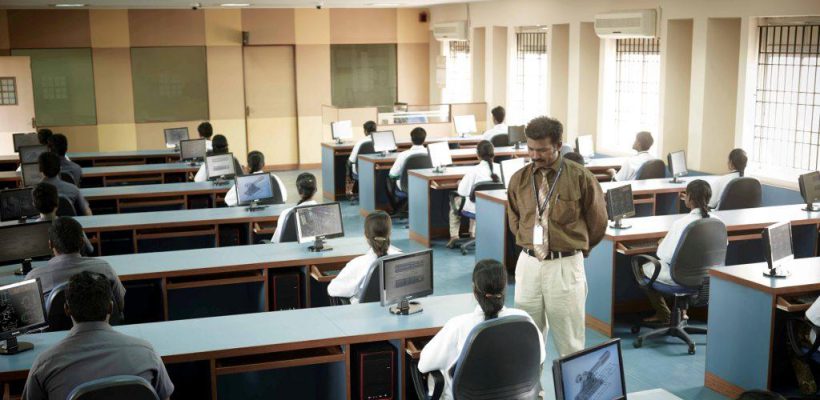
The Department of Computer Science and Engineering (CSE) was established in the year 2008 with the mission to educate students from all over India, including students from rural areas. The Department has the state-of-the-art facilities for various laboratories and Wi-Fi enabled campus to support e-Learning.
The department provides an excellent ambiance for students to learn and acquire the necessary skills required by the IT Industry. Technological innovation is so rapid in this field that continuous education is essential to enhance the skill set of students keeping in pace with the current trends.
The department has experienced faculty members who are fully committed to teaching and research. The advance curriculum requires the students to take up a broad spectrum of courses with special emphasis on desired areas of specialization. Hence, the department has brought out exceptional engineers in the past and will continue to do in the years to come. The students are actively involved in Co-curricular (CSI) and Extra Curricular (Sports and Social) activities throughout the year. The Department maintains an excellent interaction with IT industry and organizes regular guest lectures by experts, industrial visits, internships etc. and stands for industry – Institute collaboration.
The Department is renowned for cutting edge research and for imparting state of the art education. The department offers a stimulating and well-supported research and teaching environment. The department has experienced significant growth in the decade in all aspects.
Innovative Teaching & Learning
Department Vision
To produce competent computer science engineers capable of developing innovative computing solutions for industry and society through advanced technologies and research with ethical values.
Department Mission
M1: To provide strong fundamentals in computer science and emerging technologies.
M2: To develop analytical, programming, and problem-solving skills for solving complex computing problems.
M3: To promote research and innovation in artificial intelligence, data science, cybersecurity, and cloud computing.
M4: To nurture leadership, teamwork, entrepreneurship, and ethical responsibility among students.
PEO1: Apply computing knowledge to develop innovative software solutions for industrial and societal needs.
PEO2: Demonstrate leadership and teamwork in multidisciplinary software development environments with ethical values and entrepreneurial mindset.
PEO3: Pursue lifelong learning and adapt to emerging computing technologies.
PO1 : Engineering Knowledge: Apply knowledge of mathematics, natural science, computing, engineering fundamentals and an engineering specialization as specified in WK1 to WK4 respectively to develop to the solution of complex engineering problems.
PO2 : Problem Analysis: Identify, formulate, review research literature and analyze complex engineering problems reaching substantiated conclusions with consideration for sustainable development. (WK1 to WK4)
PO3 : Design/Development of Solutions: Design creative solutions for complex engineering problems and design/develop systems/components/processes to meet identified needs with consideration for the public health and safety, whole-life cost, net zero carbon, culture, society and environment as required. (WK5)
PO4 : Conduct Investigations of Complex Problems: Conduct investigations of complex engineering problems using research-based knowledge including design of experiments, modelling, analysis & interpretation of data to provide valid conclusions. (WK8).
PO5 : Engineering Tool Usage: Create, select and apply appropriate techniques, resources and modern engineering & IT tools, including prediction and modelling recognizing their limitations to solve complex engineering problems. (WK2 and WK6)
PO6 : The Engineer and The World: Analyze and evaluate societal and environmental aspects while solving complex engineering problems for its impact on sustainability with reference to economy, health, safety, legal framework, culture and environment. (WK1, WK5, and WK7).
PO7 : Ethics: Apply ethical principles and commit to professional ethics, human values, diversity and inclusion; adhere to national & international laws. (WK9)
PO8 : Individual and Collaborative Team work: Function effectively as an individual, and as a member or leader in diverse/multi-disciplinary teams.
PO9 : Communication: Communicate effectively and inclusively within the engineering community and society at large, such as being able to comprehend and write effective reports and design documentation, make effective presentations considering cultural, language, and learning differences
PO10 : Project Management and Finance: Apply knowledge and understanding of engineering management principles and economic decision-making and apply these to one’s own work, as a member and leader in a team, and to manage projects and in multidisciplinary environments.
PO11 : Life-Long Learning: Recognize the need for, and have the preparation and ability for
i) Independent and life-long learning
ii) Adaptability to new and emerging technologies and
iii) Critical thinking in the broadest context of technological change. (WK8)
KNOWLEDGE AND ATTITUDE PROFILE (WK)
WK1 : A systematic, theory-based understanding of the natural sciences applicable to the discipline and awareness of relevant social sciences.
WK2 : Conceptually-based mathematics, numerical analysis, data analysis, statistics and formal aspects of computer and information science to support detailed analysis and modelling applicable to the discipline.
WK3 : A systematic, theory-based formulation of engineering fundamentals required in the engineering discipline.
WK4 : Engineering specialist knowledge that provides theoretical frameworks and bodies of knowledge for the accepted practice areas in the engineering discipline; much is at the fore front of the discipline.
WK5 : Knowledge, including efficient resource use, environmental impacts, whole-life cost, re-use of resources, net zero carbon, and similar concepts, that supports engineering design and operations in a practice area.
WK6 : Knowledge of engineering practice (technology) in the practice areas in the engineering discipline.
WK7 : Knowledge of the role of engineering in society and identified issues in engineering practice in the discipline, such as the professional responsibility of an engineer to public safety and sustainable development.
WK8 : Engagement with selected knowledge in the current research literature of the discipline, awareness of the power of critical thinking and creative approaches to evaluate emerging issues.
WK9 :Ethics, inclusive behavior and conduct. Knowledge of professional ethics, responsibilities, and norms of engineering practice. Awareness of the need for diversity by reason of ethnicity, gender, age, physical ability etc. with mutual understanding and respect, and of inclusive attitudes.
WK – PO Mapping
| PO1 | PO2 | PO3 | PO4 | PO5 | PO6 | PO7 | PO8 | PO9 | PO10 | PO11 | |
| WK1 | ✓ | ✓ | ✓ | ||||||||
| WK2 | ✓ | ✓ | ✓ | ||||||||
| WK3 | ✓ | ✓ | |||||||||
| WK4 | ✓ | ✓ | |||||||||
| WK5 | ✓ | ✓ | |||||||||
| WK6 | ✓ | ||||||||||
| WK7 | ✓ | ||||||||||
| WK8 | ✓ | ✓ | |||||||||
| WK9 | ✓ |
PSO1: Design and develop software systems using modern programming tools, algorithms, and technologies.
PSO2: Develop innovative solutions in AI, data analytics, cybersecurity and cloud computing for industrial and societal applications.
PSO3: Able to build, deploy, and maintain web applications independently through full stack development skills.
| S.No. | TOPIC’S | VIDEO LINK |
| 1 | CS8494-Software Engineering by Dr. N.Kamal (Prof./CSE) Topic: Introduction to Software Engineering |
VIEW |
| 2 | CS8501 Theory of Computation by Dr. S. Sathya (AP./CSE) Topic: Context free grammar |
VIEW |
| 3 | CS3491 Artificial Intelligence by Mrs. V. Priya (AP./CSE) Topic: Forward and backward chaining |
VIEW |
| 4 | CS3401 Algorithms by Dr. S. Suresh (AP./CSE) Topic- Approximation Algorithms |
VIEW |
| 5 | CS8391 Distributed Systems by Mrs. S. Kalaivani (AP./CSE) Topic: Peer to Peer(P2P) Computing |
VIEW |
| S.No. | Practical Exercises | VIDEO LINK |
| 1 | 1. Implementation of Uninformed search algorithms (BFS, DFS) 2. Implementation of Informed search algorithms(A*, memory-bounded A*) 3. Implement naïve Bayes models |
VIEW |
| 2 | 4. Implement Bayesian Networks 5. Build Regression models 6. Build decision trees and random forests |
VIEW |
| 3 | 7. Build SVM models 8. Implement ensembling techniques 9. Implement clustering algorithms |
VIEW |
| 4 | 10. Implement EM for Bayesian networks 11. Build simple NN models 12. Build deep learning NN models |
VIEW |
| Content Beyond Syllabus | ||
| 5 |
|
VIEW |
| S.No | Name of the Faculty | Designation |
| 1 | Dr.N.Kamal | HOD/Professor |
| 2 | Dr.C.Murugamani | Professor |
| 3 | Dr.S.Vidhya | Asso.Professor |
| 4 | Dr.A.Suresh | Asso.Professor |
| 5 | Mrs.V.Priya | Asst.Professor |
| 6 | Ms.E.Edith Esther | Asst.Professor |
| 7 | Ms.S.Malathi | Asst.Professor |
| 8 | Mrs.S.Kalaivani | Asst.Professor |
| 9 | Mrs.V.Aarthi | Asst.Professor |
| 10 | Mrs.H.Shanmugavalli | Asst.Professor |
| 11 | Mrs.S.Shivagami | Asst.Professor |
| 12 | Mrs.B.Sindhy Bharathy | Asst.Professor |
| 13 | Ms.S.Vanathi | Asst.Professor |
| 14 | Mrs.Sibiya antony varghese | Asst.Professor |
| 15 | Mrs.P.Jayalakshmi | Asst.Professor |
| 16 | Mrs.V.Padmapriya | Asst.Professor |